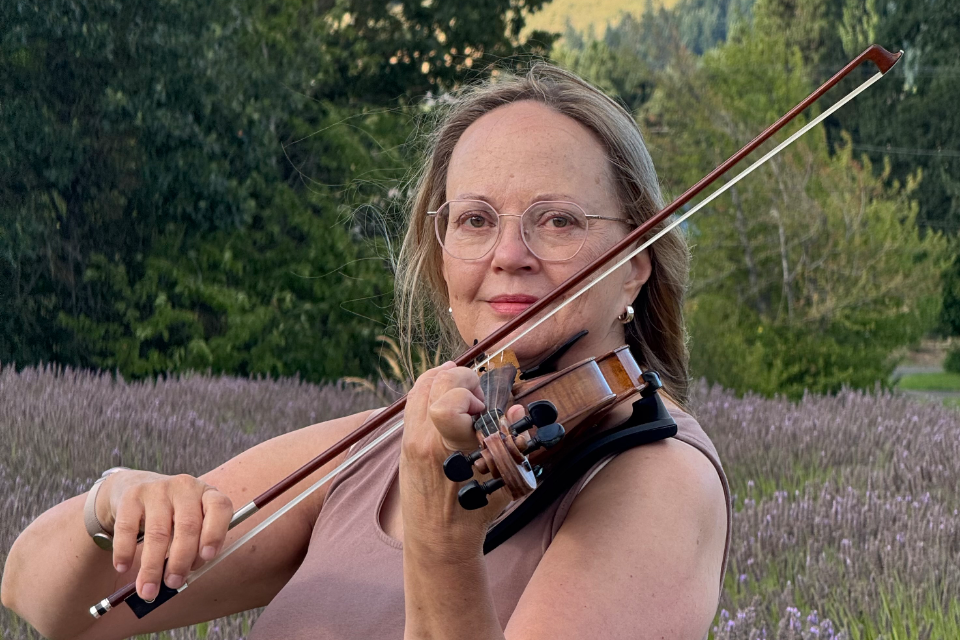
What is music culture like in Finland? Do you find it different from that of the USA?
In a nutshell Finland has a vast network of music schools and music conservatories with set standards and achievement levels leading towards professional studies in the universities. In the USA we have a countless amount of private studios with their programs through umbrella organizations like Oregon Music Teachers Association, American String Teachers Association etc. and not so many music schools.
How did you come to bring your violin and musical career all the way to Oregon?
After finishing my professional music studies at Sibelius Academy, which is like Juilliard in the USA, I was looking for a next step to build my career further. At the same time I met my American future husband and it felt natural to combine two nice things and to come to the USA. I literally had only my violin case with me when I was sitting on the plane bound for the USA, and wondering how my life would be shaping in California where I lived first before relocating to Oregon.
Your music lessons incorporate other instruments, among them the Finnish kantele. Can you tell us about this fascinating instrument?
Finnish table harp, Kantele, has a very old history and place in Finnish mythology opus called Kalevala. According to it the first Kantele was made from a giant jaw bone of a huge pike and played by a mystical and powerful Finnish wizard called Vainamoinen. He was able to achieve magical deeds with the power of singing and playing the Kantele. The art of playing Kantele and Kalevala songs traveled generation by generation until our days in only a practical form until those songs finally got written down and melodies got notated
In vast collections.
There are many who think that in order to play an instrument, you must be born with natural talent. But the Suzuki method says otherwise. Can you tell us about it, and how you apply it in your lessons?
Sinichi Suzuki says that it is possible to teach a person to play the violin using a similar process as a young child uses learning to speak. Instead of “language shower” we use term “music shower”, where a person is first listening to a music recording daily to get a general idea of music and by repetition the ear starts discriminating more and more details. Then we start repeating short music building blocks with the violin and gradually those short and easy-to-learn building blocks get connected to more and more complex combinations, following an individual’s own pace of learning.
Have you ever had any students who thought they couldn't do it, but were able to prove to themselves otherwise?
Suzuki method gives a firm start to a student as a reliable stepping stone but I have noticed that sometimes new students — especially adults — have a bit of a harder time with their already fixed coordination to trust on their success in the beginning of playing the violin. Adults are also sometimes very busy with work and family life, and that can put some delays on the regular practice — the only reliable way to make progress. Knowing this ahead of time can help one to build a lifestyle wherein there is a good chance to practice enough and enjoy the feeling of constant progress. Where there is a will there is a way!
To visit Elisa's official page, click
HERE!